Participate in the

x NeuroBench
Challenge 2026
March - August, 2026
Participate in the
March - August, 2026
A Brain-Computer Interface (BCI) is a system that translates neural activity into commands for external software or hardware. This challenge specifically focuses on the Motor Imagery (MI) paradigm.
Moving technology out of the clinical lab and into wearable decoders for motorized wheelchairs and robotic prosthetics.
Life-changing potential for those with stroke, ALS, or spinal cord injuries.
The OpenBMI dataset provides an unprecedented scale of high-quality EEG recordings, distinguishing it from smaller, legacy datasets that often suffer from overfitting.
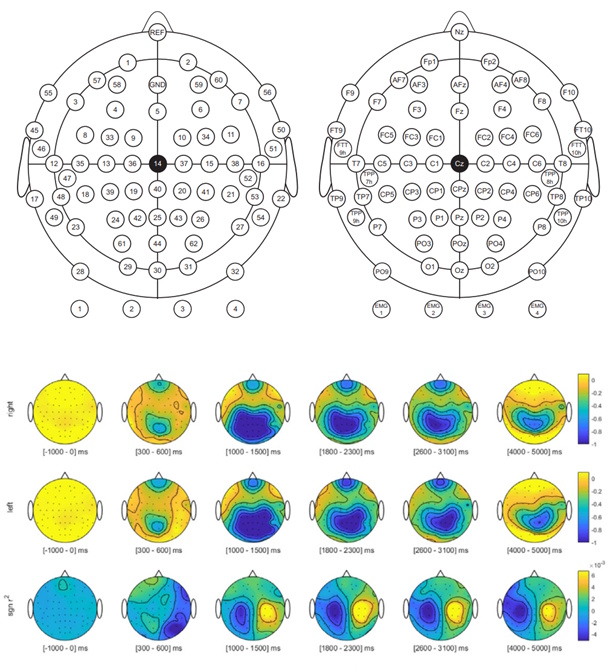
The OpenBMI dataset provides an unprecedented scale of high-quality EEG recordings, distinguishing it from smaller, legacy datasets that often suffer from overfitting.
Ref Publication: Lee, Min-Ho, et al. "EEG dataset and OpenBMI toolbox for three BCI paradigms: An investigation into BCI illiteracy."GigaScience8.5 (2019): giz002.
During the online test phase, the fixation cross appeared at the center of the monitor and moved right or left, according to the real-time classifier output of the EEG signal.
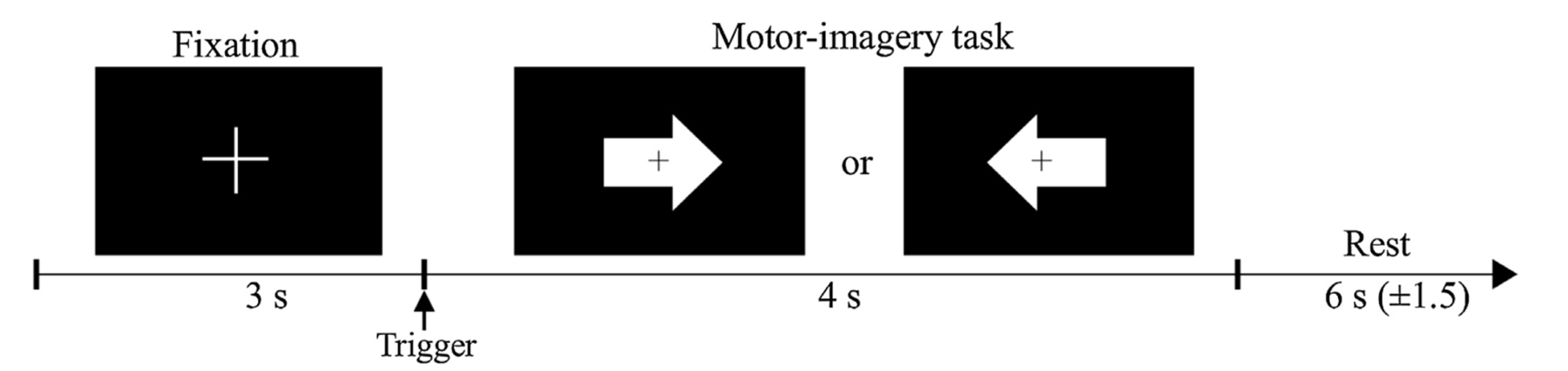
A specific subset of the OpenBMI dataset focusing on 20 electrodes in the motor cortex region.
The first 3s of each trial began with a centered black fixation cross.
Next, the subject performed the imagery task of grasping with the appropriate hand for 4s when the right or left arrow appeared as a visual cue.
During the MI task, subjects were prompted with visual cues to imagine the kinetic movement of either their left hand or right hand (a two-class classification problem). Each trial consists of a 4-second active imagination phase, flanked by resting baselines. This yields 100 trials per class, per session, for each individual subject. Participants must design a neuromorphic model architecture to classify the EEG-MI signals as either left or right hand movements.
Standard Deep Neural Networks (DNNs) ingest continuous, floating-point analog signals. However, neuromorphic architectures operate on event-driven, binary logic. Therefore, the continuous EEG amplitudes must be converted into discrete, asynchronous spike trains before processing. For this challenge, the preprocessed data provided at the link below is mandatory for participants in both tracks. The code harness is also provided alongside examples of suitable solutions with baseline benchmarks for the challenge.
To rigorously evaluate the real-world viability of the submitted neuromorphic models, the challenge implements a strict, multi-phase cross-validation strategy designed to test generalization capabilities.
The baseline capability of the model to correctly classify left-hand versus right-hand motor imagery. A baseline benchmark of average accuracy across the test splits will be provided to all participants after registration.
Instead of counting dense Multiply-Accumulate (MAC) operations used in standard GPUs, the harness calculates the number of effective Synaptic Operations (SynOps) triggered by the sparse spike trains. Fewer spikes and sparser activations mean lower energy consumption on the THOR architecture. In addition, submissions in Track 2 will be evaluated based on their memory usage (Footprint).
Participation is open to all parties from any global institution, university, organization, laboratory or research group. Organizing members, and directly affiliated groups will not be permitted to participate.
To recognize the engineering breakthroughs achieved during this event, we are proud to partner with the Edge AI Foundation, which has generously sponsored a $1,000 prize pool for the inaugural THOR NeuroBench Challenge. The top-performing team in each category will be rewarded independently:
Beyond the monetary awards, the winning teams will have their methodologies highlighted on the THOR Neuromorphic Commons website and will be granted priority access to THOR research infrastructure for their future research endeavors for the coming year.
For any queries regarding the challenge dataset, neurobench code harness, evaluation and rules; contact
For any queries regarding the challenge schedule, registration and other details; contact